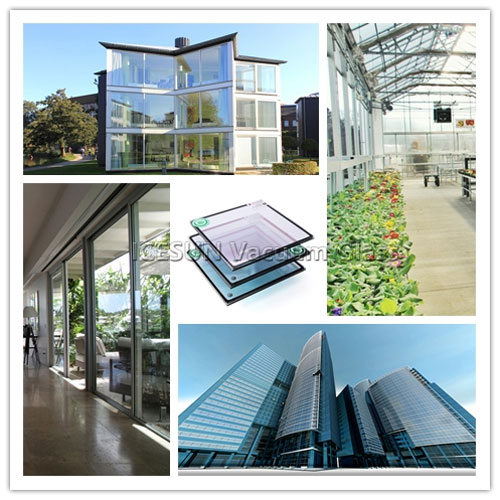
Tempered vacuum glass is an upgraded version of vacuum glass. It not only inherits all the characteristics of vacuum glass, but also greatly improves its performance. Its main feature is that the glass used is toughened safety vacuum glass. Tempered vacuum glass can be widely used in buildings, vehicle and ship doors and windows, insulation boxes and cabinets (such as display cabinets, refrigerated cabinets) and other fields requiring transparent thermal insulation materials. Our tempered vacuum glass is separated by a 0.2mm high support, and the edges of the two layers of glass plates are sealed with low-temperature glass, and then the air is discharged. The vacuum degree between the glasses is 10-4 Pa, so the thermal convection no longer exists, the heat conduction is reduced to the limit, and the Low-E layer reflects more than 95% of the infrared radiation. Therefore, the heat between the inner and outer glass plates cannot be exchanged, achieving excellent thermal insulation effect.
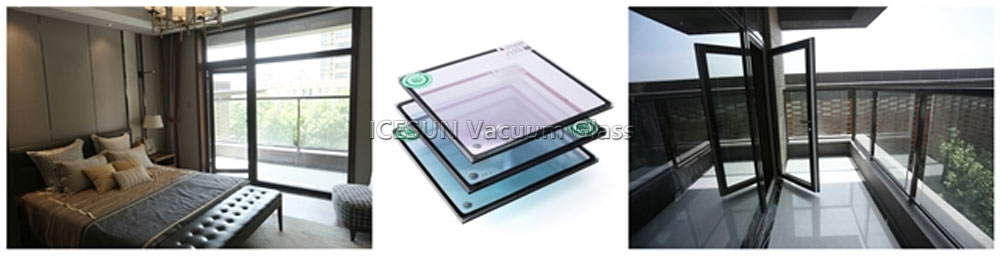
Development History of Tempered Vacuum Glass
Vacuum glass, as a high-end product in the glass industry, originated from Dewar bottles, that is, thermos bottles. The utility model is a glass product which is separated by two or more flat glasses with supports, the periphery is sealed, and a vacuum layer is formed between the glasses. With the advent of flat vacuum glass samples developed by the University of Sydney in the 1990s, the research and development of vacuum glass in the glass industry has never stopped. From vacuum to support, from sealing materials to sealing technology, the performance of vacuum glass in heat insulation, sound insulation and noise reduction is becoming more and more excellent.
However, with the wide application of vacuum glass, how to give the safety performance of vacuum glass has become a major problem perplexing the glass industry for a long time. However, Icesun, a glass deep-processing enterprise, combines vacuum glass with toughening technology and integrates unique vacuum glass manufacturing technology, tempered vacuum glass came into being. This is a safety vacuum glass with independent intellectual property rights in China. This tempered vacuum glass not only has excellent characteristics of energy conservation and heat insulation, sound insulation and noise reduction, and prevention of condensation, but also has the safety advantages of high strength and wind pressure resistance, which has raised the level of China's glass deep processing to a higher level and led the world.
Features of Tempered Vacuum Glass
-
Adopting the unique low temperature melting point welding technology and aerospace grade welded glass for edge sealing, ICESUN tempered vacuum glass completely retains the safety characteristics of tempered glass, such as high strength and impact resistance. The fulcrum in the glass is placed automatically by the machine so that the stress distribution on the surface of tempered vacuum glass is uniform, and the glass is clamped automatically when vacuumizing, with a vacuum degree of 10-4Pa, which fully meets the stress requirements of tempered glass.
-
The vacuum degree between the glasses is 10-4 Pa, so the thermal convection no longer exists, the heat conduction is reduced to the limit, and the Low-E layer reflects more than 95% of the infrared radiation, ensuring that the heat transfer coefficient (U value) of the ICESUN tempered vacuum glass is as low as 0.38w / (M2 · K). At the same time, the thermal insulation performance of tempered vacuum glass is 2-4 times that of hollow glass and 6-10 times that of single glass. Independent use can meet the requirements of international passive house for heat transfer coefficient of doors and windows.
-
Compared with the condensation problem caused by the internal and external temperature difference of insulating glass, ICESUN tempered vacuum glass with the inner cavity in a high vacuum state eliminates the internal condensation phenomenon. Besides, the excellent heat insulation capacity makes the inner surface of the glass free of condensation even if the outdoor temperature drops to - 50 ℃.
-
Tempered vacuum glass has significant sound insulation effect on medium and low frequency noise with strong penetration. The high vacuum cavity of tempered vacuum glass effectively blocks the propagation of sound. Human ears are sensitive to hearing. For every 5 dB difference, the difference of auditory perception is 3-4 times. According to the ratio of professional weighted sound insulation, the sound insulation of 75 dB outdoor noise and ICESUN tempered vacuum glass can reach 41 dB, which is much better than the standard of 29 dB insulating glass, especially friendly for medium and low frequency noise that puzzles people, such as traffic noise and construction noise.
-
Tempered vacuum glass is not affected by use area, altitude and installation angle. When the tempered vacuum glass is used horizontally or obliquely, the heat transfer coefficient is constant, and it can be installed on the top and inclined top of buildings to ensure energy-saving benefits.
Applications of Tempered Vacuum Glass
Tempered vacuum glass has excellent thermal insulation, sound insulation and noise reduction, light, transparent, safe and stable performance, which helps the development of green buildings. Moreover, tempered vacuum glass has excellent sound insulation and noise reduction, heat insulation and non condensation performance and transparent daylighting field of vision. It is the best choice for vehicle window glass materials. Besides, the refrigerator door made of traditional glass always has obvious frosting and condensation, which affects its beauty and permeability. At the same time, the electric heating defrosting scheme for the cabinet door would produce a lot of additional energy consumption. Fortunately, the use of tempered vacuum glass makes home appliances energy-saving, environmental protection and beautiful. In addition, tempered vacuum glass is also suitable for all kinds of glass greenhouses for planting and breeding in modern agriculture. What`s more, tempered vacuum glass has the performance advantages of thermal insulation and constant inclination, making it the best lining glass in the field of building solar power generation.