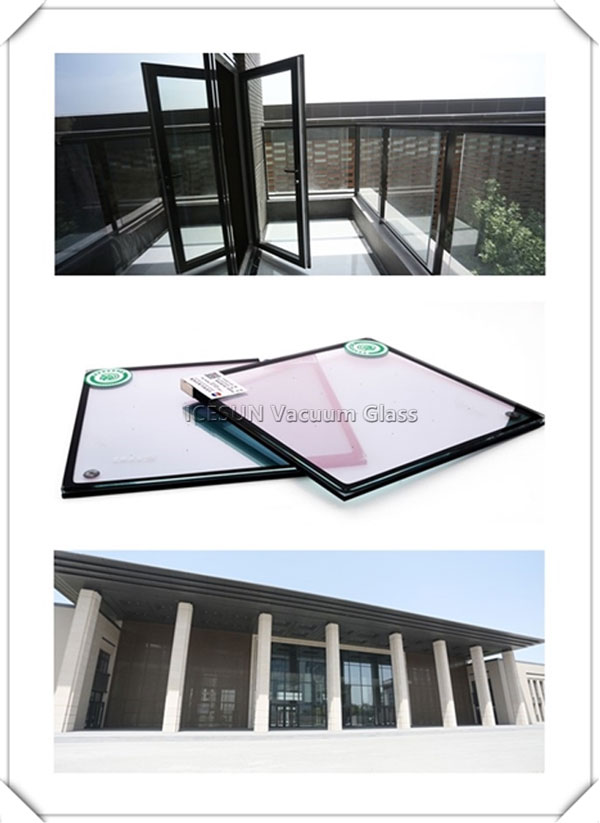
Tempered vacuum glass has the ability to break through the bottleneck of passive house. Passive buildings have a clear energy-saving index, which requires that the external wall heat transfer coefficient ≤ 0.4W / (㎡ K). Super energy-saving window is a key problem. Most of the building energy loss in China is lost from the window. Since the wall has clear regulations to increase the insulation layer, the wall must meet the requirements of energy saving while the window adopts Low-E glass, three-layer glass with two-layer inert gas, three-layer insulating glass and so on. Although the requirements of heat transfer coefficient of 1-2 are met in a short time, the service life is not long. For example, Low-E glass is easy to oxidize when exposed to the air. After 1-3 years of use, it will fade. Each piece of glass has different oxidation degree and becomes a big flower face. The color of each piece of low-e glass is different, which affects the beauty, increases the heat transfer coefficient, and the energy-saving windows cannot meet the requirements of energy saving. Besides, inert gas would be lost after 2-3 years of use. Similarly, the heat transfer coefficient increases, and the energy-saving window also cannot meet the requirements of energy saving.
Is there an energy-saving glass solution once and for all? What about energy-saving window solutions with the same service life and service life of 50 years or even the same life as buildings? The answer is yes. That is the solution of vacuum glass for energy-saving window - ICESUN tempered vacuum glass. Aerospace grade welded glass and tempered glass block gas leakage through the strong combination of chemical agents. 50 years lifespan of high vacuum has perfectly retained the low radiation and energy-saving activity of nano silver film. For our tempered vacuum glass, the disadvantages of air leakage of organic glue and metal edge sealing are avoided, and the international problem of oxidation failure of Low-E glass is eradicated. ICESUN tempered vacuum glass has passed the American IGCC certification. The condensation temperature of this vacuum glass is below - 50 ℃.
In a word, tempered vacuum glass has good thermal insulation performance, with a minimum heat transfer coefficient of 0.19w (m * k). For tempered vacuum glass with palm thickness, its thermal insulation performance has exceeded that of brick wall with 1m thickness.