

With the implementation of national energy-saving regulations and green building policies, vacuum glass has become the preferred architecture glass for energy-saving doors and windows in green buildings such as passive houses, low-energy buildings and zero energy buildings.
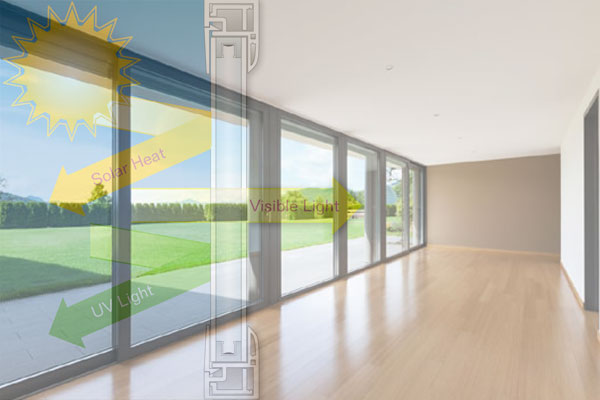
What is Vacuum Glass?
As a new type of glass deep processing product, vacuum glass is developed based on the principle of thermos bottle. Vacuum glass is to seal the periphery of two flat glasses, draw vacuum from the gap and seal the exhaust hole. ICESUN vacuum glass currently on the market is made of 4mm high support to separate the two glasses, seal the edges of the two glass plates with low-temperature glass, and then discharge the air. Generally, at least one of the two pieces of vacuum glass adopts Low-E layer, so as to minimize the heat lost through the conduction, convection and radiation of vacuum glass. The working principle of vacuum glass is the same as that of glass thermos.
Vacuum glass forms a vacuum layer between two glass substrates. Because the conduction and convection of heat energy cannot be carried out in vacuum, vacuum glass can more effectively isolate the transmission of heat energy and has good thermal insulation performance. Therefore, whether in summer or winter, vacuum glass can make the indoor temperature less vulnerable to the outdoor temperature. When buildings in various countries are developing towards zero carbon buildings, Vacuum glass has become the preferred energy-saving building materials.
How to Make Tempered Vacuum Glass
Wash the two tempered glass plates;Metal supports with a height of 0.4mm should be placed on a glass plate at an interval of 10 ~ 25mm; Put on another glass plate; Apply welding glass around the two glass plates; Heat at 450 ℃ for 15 ~ 60 minutes, and seal the edges of the two glass plates with welded glass to form a whole; Open a hole at an appropriate position and vacuum to make the vacuum pressure between the two glass plates reach 10-4, that is, vacuum glass is formed.
Generally speaking, the whole production and preparation process of vacuum glass involves nearly 100 production links, which requires strict production environment and high process accuracy. If not combined with advanced automation technology, the production efficiency will be too low, which will directly affect the performance and stability of vacuum glass and lose the commercial application value of products.
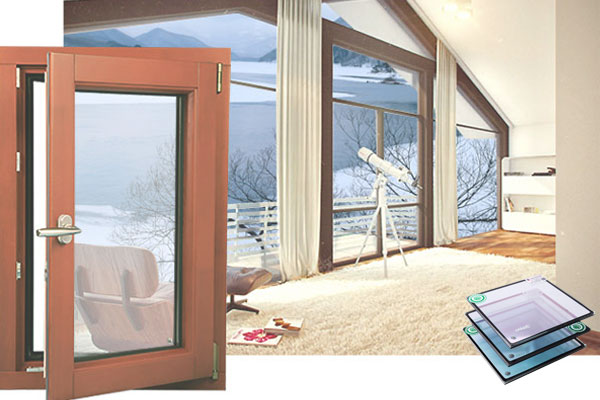
Why is Vacuum Glass Energy Efficient?
Energy-saving glass usually refers to glass with good thermal insulation and shading properties. The application of this type of glass can greatly reduce the power consumption of residential and office buildings, and save the use of air conditioning and heating. In winter, the escape of indoor heat can be greatly reduced, and in summer, sunlight can be reduced to enter the room. Energy-saving glass, as an important building energy-saving material, has been playing an increasingly important role in promoting building energy-saving in China. Vacuum glass is the glass with the best energy saving effect at present. Vacuum glass forms a vacuum between two sealed glass pieces so that the conduction heat between glass and glass is close to zero. At the same time, at least one piece of vacuum glass is generally Low -E low-e glass, so that its convection, radiation and conduction heat transfer are very small, and the energy saving effect is very good. Heat loss through windows can be reduced by using vacuum glass. These special windows have vacuum layer between two panes of glass. If the vacuum glass has a vacuum, there will be no conduction or convection, so there will be no heat loss by conduction.