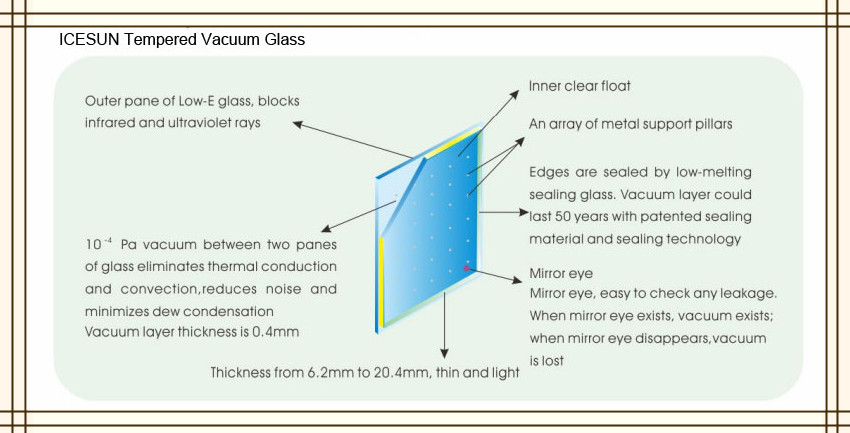
Vacuum glass has similar structure with a double glazed unit, except that vacuum glass has no gas in the cavity, it is vacuum.Vacuum glass is to seal the two pieces of tempered glass around, vacuumize the gap and seal the exhaust hole. The gap between the two pieces of tempered glass is 0.4mm. Generally, at least one of the two pieces of vacuum glass is low emissivity (low-e) glass, so the heat dissipation through conduction, convection and radiation of vacuum glass is minimized, and its working principle is the same as that of glass thermos.
Creating a vacuum layer between two pieces tempered glass could be up to five times more effective when insulating a room than standard double glazing technology. Vacuum glass (or VG) can exceed triple glazing with less weight and bulk. For example, 12.4 mm thick tempered vacuum glass, thermal insulation performance and heat resistance performance may be up to 3 times as much as 32 mm thick German triple insulating glass.
Working Principle of Vacuum Glass
From a principle point of view, vacuum glass can be compared to a flat-shaped thermos bottle. The same point between the two is that the inter layer of the two layers of glass is a vacuum with a pressure lower than 10-1pa (10-4 pa for vacuum glass), so that the heat transfer of the gas can be ignored. Besides, the inner walls of both are plated with Low-E film to make radiative heat transfer as small as possible. The differences between the two are as follows: First, the vacuum glass used for doors and windows must be transparent or light-transmitting. It cannot be plated with opaque silver film like a thermos. Or the spherical thermos becomes a flat plate, and a square array of "supports" must be set up between the two layers of glass to withstand the atmospheric pressure of about 10 tons per square meter, so that the glass is kept spaced to form a vacuum layer. The spacing of the "support" square array is designed according to the thickness of the glass plate and mechanical parameters, and is between 20mm-40mm. In order to reduce the heat transfer formed by the "thermal bridge" of the support and make it difficult for the human eye to distinguish, the diameter of the support is very small (about 0.3mm-0.5mm). Further to this, vacuum glass provides much better performance in terms of sound proof or noise reduction. Due to the vacuum layer, it cannot conduct noise, so vacuum glass can isolate 90% of noise. Just as the famous film line says, [In space, no one can hear you scream!"
The life expectancy of ICESUN tempered vacuum glass can reach more than 50 years. It has a high vacuum inner cavity, so that the gas heat transfer can be ignored. At the same time, high-performance Low-E glass is used to greatly suppress radiation heat transfer and ensure the heat transfer coefficient of ICESUN vacuum glass (U value) as low as 0.4W/(m2·K). At the same time, the thermal insulation performance of ICESUN vacuum glass is 2-4 times that of insulating glass, and 6-10 times that of single glass. It can meet the requirements of international passive house for heat transfer coefficient of doors and windows when used independently.