

Under the background of the increasing shortage of energy and the high proportion of building energy consumption, ultra-low energy consumption buildings such as passive buildings and net zero energy consumption have become the hot favorites of the global construction industry, and many countries are vigorously developing them. The European Union issued the Energy Efficiency of Buildings Directive (EPBD) in 2010, which stipulates that in 2018, all new public buildings owned or used by the government should meet the requirements of near-zero energy consumption; in 2020, all new buildings should meet the requirements of near-zero energy consumption. The U.S. Department of Energy's "Net-Zero Energy Commercial Building Initiative" proposes that by 2030, all new public buildings will be constructed in accordance with net zero energy standards; by 2040, 50% of existing public buildings will meet net zero energy requirements; By 2050, all public buildings reach net zero energy consumption. Our country's building energy efficiency standards are gradually improving and improving. In October 2016, Beijing issued the "Beijing Action Plan for Promoting the Development of Ultra-Low Energy-Consumption Buildings (2016-2018)", which is proposed to "build an ultra-low-energy-consumption demonstration building of no less than 300,000 square meters within three years". "The goal is that for social investment projects, the municipal finance will give incentive funds ranging from 600 to 800 yuan per square meter. As a complex, the building can be improved in many aspects to achieve the purpose of energy saving, and the transparent envelope is the main window for the energy dissipation of the whole building, so improving the energy-saving performance of glass should not be underestimated. As the most high-end and energy-saving product, vacuum glass has been developed in China for nearly 20 years. From the initial laboratory sample to the current large-scale application product, more and more people have come to know and understand it. More engineering projects prefer to use vacuum glazing for energy efficiency.
Introduction of ICESUN Tempered Vacuum Glass
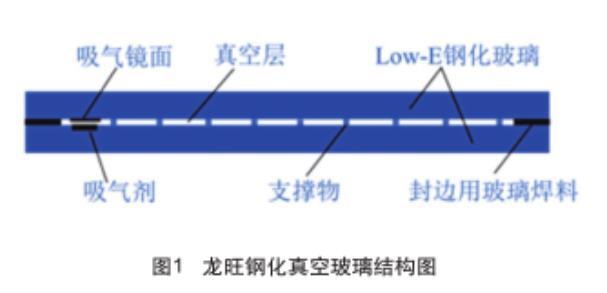
As shown in Figure 1, ICESUN tempered vacuum glass is composed of two flat tempered glass, the edges are sealed to form a vacuum chamber, and evenly arranged supports are placed in the middle, with a height of about 0.2mm. One of the corners is provided with a suction pipe, and the gas is discharged from the suction pipe. In order to maintain the life of the vacuum glass, a suction material is placed at the suction port, and the color of the suction mirror changes from black to white, and the customer can identify that the tempered vacuum glass has failed. We call it the "vacuum eye".
Using the same original glass sheet, the central heat transfer coefficient comparison between ICESUN tempered vacuum glass and other glass is shown in Table 1.
Table 1 Heat Transfer Contrast of ICESUN Tempered Vacuum Glass and Other Glass
|
No. |
Glass Type |
Glass Structure |
Low-E Glass Emissivity |
Central heat transfer coefficient U Value |
|
1 |
ICESUN Tempered Vacuum Glass |
6Low-E+V+6 |
0.021 |
0.25 |
|
2 |
Low-E Common Vacuum Glass |
6Low-E+V+6 |
0.021 |
0.59 |
|
3 |
Triple Low-E Insulating Glass |
6Low-E+12Ar+6+12Ar+6Low-E |
0.021, 0.096 |
0.76 |
|
4 |
Low-E Insulating Glass |
6Low-E+12Ar+6 |
0.021 |
1.36 |
|
5 |
Common Insulating Glass |
6+12Ar+6 |
- |
2.6 |
It can be seen from Table 1 that the heat transfer coefficient of ICESUN tempered vacuum glass is significantly lower than that of ordinary vacuum glass, Low-E insulating glass and ordinary insulating glass. The internal vacuum degree of ICESUN tempered vacuum glass is higher than 0.01Pa, and the thermal conductivity of gas convection is basically negligible. At the same time, Low-E coated glass is used, which basically isolates the radiation heat conduction. Since the strength of the original glass sheet is increased by 5 times after tempering, the distance between the supports can be expanded from 25mm to 60mm of ordinary vacuum glass, the supports per square meter are reduced by 85%, and the thermal conductivity of the supports is greatly reduced. Based on the above factors, the central heat transfer coefficient of ICESUN tempered vacuum glass can be reduced to 0.25W/(m2·k), while that of ordinary vacuum glass is 0.59W/(m2·k), and that of Low-E double insulating glass is 0.76W/(m2·k), Low-E insulating glass is 1.36W/(m2·k).
In addition, the strength of ICESUN tempered vacuum glass: the wind pressure resistance reaches the national highest standard of grade 9 (±5KPa), the temperature difference is 140 ℃ without explosion, the impact resistance has passed the SGCC certification of the United States, and the stress of all parts of the glass surface is uniform. Greater than 95Mpa. In terms of safety: the sound insulation performance exceeds 38 decibels (1.41 times that of insulating glass), the number of particles within the range of 50mm × 50mm after breaking is greater than 40 (meeting the national standard for tempered glass), ultra-thin and ultra-light, which solves the problem of window opening and fan too much. It can seriously cause the problem of deformation and sagging of window frames and hardware. It can be directly laminated with PVB (or SGP) to avoid self-explosion and falling and hurt people. After compounding, it can meet various fire-proof grade requirements and bulletproof requirements. The house color and thermochromic function can achieve the external shading effect while simplifying the structure (greatly reducing the cost) and reducing the operation risk of the glass curtain wall maintenance spider man. The above characteristics make ICESUN tempered vacuum glass solve a series of world problems in thermal insulation, strength and safety in the fields of building curtain walls and lighting roofs.
ICESUN tempered vacuum glass makes passive house more energy-efficient, more comfortable and longer
Taking Hebei Province`s local standard [Energy-saving Design Standards for Passive Low-Energy Residential Buildings" (DB13(J)/T177-2015) as an example, the heat transfer coefficient K value of the whole window is required to be ≤1.0W/(m2·k), and the heat transfer coefficient of glass is required to be ≤1.0W/(m2·k). The coefficient K value is less than or equal to 0.8W/(m2·k).
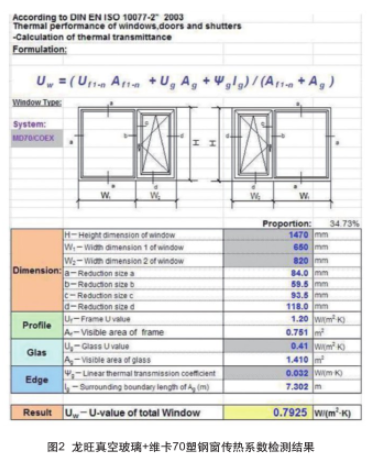
Thermal insulation: The vacuum layer inside ICESUN tempered vacuum glass has good heat insulation ability. After testing by a third-party organization, ICESUN tempered vacuum glass with a heat transfer coefficient of 0.4 W/(m2·k) is installed in Vicat 70 plastic steel profiles, the heat transfer coefficient has reached 0.792 W/(m2·k), which fully meets the requirements of passive house. (figure 2)
Anti-condensation: Due to the low heat transfer coefficient of ICESUN tempered vacuum glass, under severe temperature difference conditions, the surface of indoor and outdoor glass is closer to the ambient temperature, thus greatly reducing the possibility of condensation. Under normal use environment, the surface of ICESUN tempered vacuum glass will not condense. The phenomenon of condensation on other glass is more common, especially in winter when the temperature difference is large. After condensation, in addition to the glass not being able to remain transparent, the dew will infiltrate the sealant between the glass and the profile, resulting in mold and other problems.
Sound insulation: The vacuum chamber has excellent sound insulation ability. ICESUN tempered vacuum glass is matched with Vika plastic-steel profiles, and the sound insulation effect of the whole window is better than 38 decibels.
Service life: Because the edge is sealed with inorganic materials, and the suction material is placed inside, multiple technical means are used to make the ICESUN tempered vacuum glass and the passive house as long as possible (more than 50 years).
Regional applicability: Because there is no gas flow inside ICESUN tempered vacuum glass, it is not limited by ambient air pressure and use angle, and its thermal insulation ability remains unchanged, which can be adapted to different parts of the world and buildings.