

Vacuum glass has excellent heat insulation performance and super sound insulation and noise reduction performance, and vacuum glass has begun to be widely used at home and abroad. When comparing the thermal insulation performance of vacuum glass, the expressions used by domestic and foreign industries are different. China and Europe use the K value, the United States uses the U value, and some use the R value. So what is the difference between U value, K value, and R value of vacuum glass?
The concepts and definitions of vacuum glass U value and K value are basically the same, and they are both physical quantities that measure the heat transfer performance of materials, that is, heat transfer coefficient. The U value and K value of vacuum glass are both defined as: under standard conditions, under a certain temperature difference on both sides of vacuum glass, the heat transferred to the other side through unit area per unit time. The metric units for both the U value and the K value of vacuum glass are W/㎡·K.
However, the U value and the K value of vacuum glass are not exactly same. The difference is that the boundary conditions required by the respective test standards are different. The Chinese K value test is based on the Chinese GB10294 standard; the European K value test is based on the European EN673 standard; the American U value test is based on the American ASHRAE standard, and the American ASHRAE standard divides the U value test conditions into winter and summer.
Therefore, for the same piece of vacuum glass, the heat transfer coefficients measured by different standards have different numerical results. European and American countries are accustomed to using imperial units, and the imperial unit of heat transfer coefficient U value (or K value) is BTU/h·ft2·℉.The conversion relationship between the metric unit and the imperial unit of the heat transfer coefficient (U value or K value) is:
1 BTU/h·ft2·℉=5.678 W/㎡·K or 1 W/㎡·K=0.176 BTU/h·ft2·℉
In addition, European and American countries are accustomed to using the thermal resistance value (R value) of glass to compare the thermal insulation performance of different glass materials. The thermal resistance value R is used to reflect the ability of the insulating material to prevent heat from passing through. The greater the thermal resistance value R of the material, the stronger its ability to prevent the passage of heat, and the more suitable it is as a thermal insulation material.
The thermal resistance value R and the heat transfer coefficient U value (or K value) have a reciprocal relationship with each other, namely:
U=1/R or R=1/U
The metric unit of thermal resistance value R is ㎡·K/W, and the imperial unit is: ft2·h·°F/BTU.
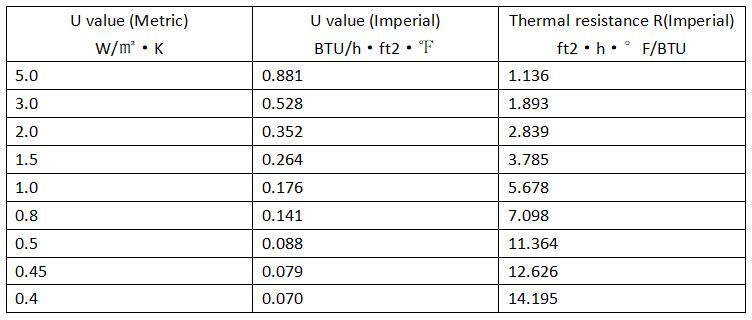
The following table lists the corresponding relationship between the metric system, imperial system and the corresponding thermal resistance value R (imperial system) of several U value data:
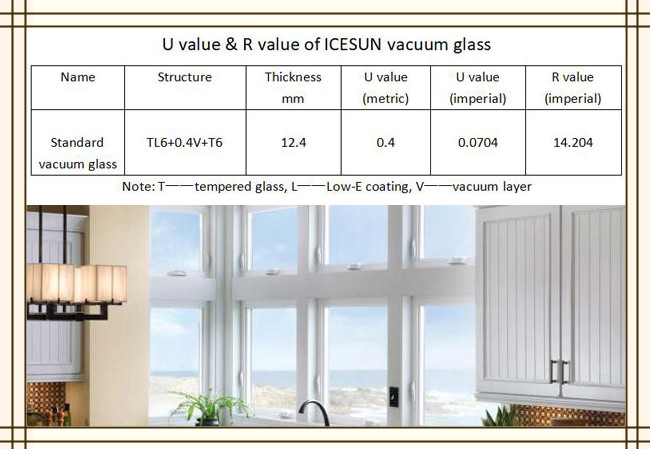
U value & R value of ICESUN vacuum glass

Note: T--tempered glass, L--Low-E coating, V--vacuum layer