

This standard is proposed by China Building Materials Federation.
This standard is under the jurisdiction of the National Standardization Technical Committee of Glass for Construction (SAC/TC 255).
The drafting units of this standard include China Building Materials Inspection and Certification Group Co., Ltd., ICESUN Vacuum Glass Ltd., National Safety Glass and Quartz Glass Quality Supervision and Inspection Center and many other units.
The main drafters of this standard: Huang Xiaolou, Zhang Congcong, Li Hongyan, etc.
This standard specifies the requirements, test methods, inspection rules, packaging, marking, transportation and storage of vacuum glass. This standard applies to vacuum glass for construction and home appliances, and vacuum glass for other purposes can be used as a reference.
Thermal insulation performance: The thermal insulation performance of vacuum glass should meet the requirements of the following table.
Grade of thermal insulation performance of vacuum glass
|
Grade |
Heat Transfer Coefficient W(m2*K) |
|
I |
≤1.0 |
|
II |
1.0<U value(K value)≤2.0 |
Sound insulation performance: The weighted sound insulation Rw of vacuum glass for construction shall not be less than 35dB, and the weighted sound insulation Rw of vacuum glass for other purposes shall be agreed upon by both parties.
Structural Characteristics and Performance Features of Typical Vacuum Gass
A typical vacuum glass is a glass product in which two pieces of flat glass are separated by a support, and the periphery is sealed (using low-melting glass solder or metal solder) to form a vacuum cavity between the glasses. The vacuum pressure in the vacuum chamber should not exceed 1Pa, and can generally be controlled at 0.1Pa-0.01Pa or lower. Due to the external atmospheric pressure, it is necessary to set up a "support" between the two layers of glass to maintain a gap between the glasses to form a vacuum layer. The arrangement form and spacing of the "supports" can be determined according to the thickness of the glass, the type, material, shape, size of the supports, and related stress and mechanical parameters. Usually, in order to reduce the heat transfer formed by the "thermal bridge" of the support and improve the visual effect at the same time, the diameter of the support is generally between 0.3mm - 0.5mm, the height is between 0.1mm - 0.4mm, and the spacing is generally 20mm - Between 60mm.
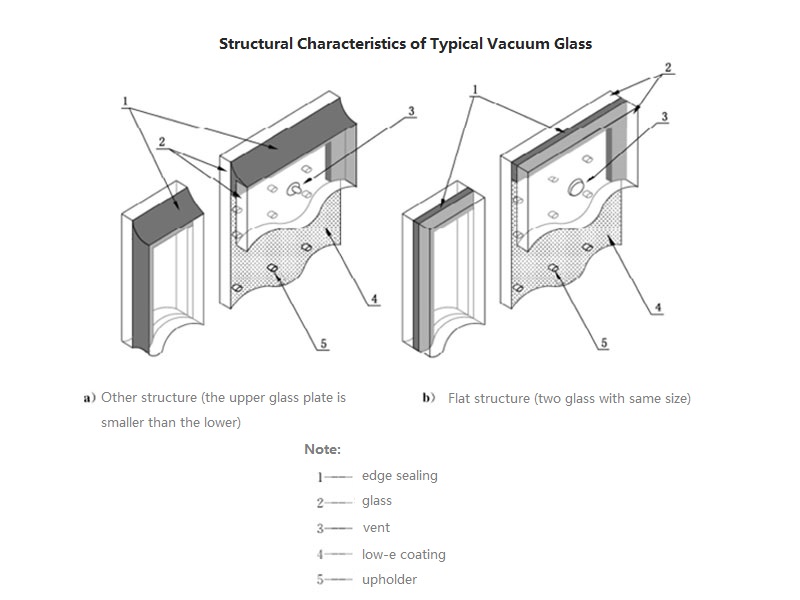
There is very little gas in the vacuum glass cavity, and the convective heat transfer of the gas in the cavity is very small, so the heat transfer coefficient is low. In order to further improve the thermal insulation performance of the vacuum glass, at least one piece of low-emissivity coated glass can be used in the vacuum glass substrate, which will reduce the radiation heat transfer of the vacuum glass, thereby further reducing the heat transfer coefficient of the vacuum glass. Due to the existence of the vacuum cavity, the vacuum glass effectively blocks the transmission of sound, and the sound insulation effect is very good. At the same time, vacuum glass also has the characteristics of good anti-condensation effect, heat transfer coefficient not affected by placement angle, and long service life.
Since the strength of tempered glass is higher than that of ordinary glass, vacuum glass made of tempered glass can improve the ability of vacuum pump glass to resist external atmospheric pressure to a certain extent. Compared with the vacuum glass made of ordinary glass, its mechanical properties (wind pressure resistance, temperature difference resistance, impact resistance, etc.) can also be improved. At the same time, the distance between the supports of the vacuum glass made of tempered glass can be appropriately expanded, which can further reduce the heat transfer coefficient of the vacuum glass, improve the thermal insulation performance, and at the same time the glass is more beautiful.
Because vacuum glass has excellent thermal insulation, sound insulation, anti-condensation and other properties, vacuum glass and its composite products can be used in construction, household appliances and other fields. When vacuum glass and its products are used in these fields, all performance tests should be carried out in accordance with relevant laws and regulations, product standards and design specifications.